Choosing the Right Stone: Countertops + Backsplashes
There is no best stone. There is only the right stone for a specific household, a specific design intent, and a specific tolerance for the way a surface changes over time.
That distinction matters more than any material comparison chart, because nearly every countertop disappointment we've been called in to look at traces back to the same root cause: the material was chosen for how it photographed, not for how it behaves. A honed Calacatta island is a beautiful decision and a defensible one — but only if the homeowner understands, before the deposit is written, that a splash of lemon juice will leave a dull mark that no sealer on earth would have prevented.
What follows is how we think through stone selection on custom homes and high-end remodels. It's written for homeowners, but we've kept the technical detail intact, because the architects and designers we partner with are going to read the same page and we'd rather be useful to both.
Start with Five Questions, not a Slab Yard
Walking a slab yard first is the most common sequencing mistake in the process. You will fall in love with something, and then spend the rest of the project rationalizing it. Answer these first:
Who actually cooks, and how? A household that sears steaks and breaks down citrus every night is a different specification than one that entertains four times a year. Be honest rather than aspirational.
What is your tolerance for patina? Some clients find the developing character of soapstone or honed marble genuinely beautiful. Others experience the first etch mark as damage. Neither reaction is wrong, but they lead to opposite material choices, and the answer is almost impossible to change later.
Where does this surface live? Perimeter counters, working islands, butler's pantries, powder room vanities, fireplace surrounds, and outdoor kitchens each have different exposure. A stone that is a poor choice for a working island can be a superb choice thirty inches away on a bar.
What is the design doing? If the stone is meant to be quiet — a neutral field under cabinetry and hardware that carry the room — that is a different material and a different budget than a dramatic bookmatched feature wall.
What is the real number? Stone is typically quoted per installed square foot, but the slab is only part of it. Mitered edges, waterfall ends, full-height backsplashes, integral drainboards, and complex cutouts add fabrication labor that can rival the cost of the material itself. Set a number that includes fabrication and installation, not just the slab.
The Materials
Marble
What it is: Metamorphosed limestone, primarily calcium carbonate. Mohs hardness around 3.
Why people choose it: Nothing else looks like it. The translucency, the soft grey-on-white veining, the way a honed surface takes light — marble is the reference standard that every engineered product is trying to imitate, and the imitations are still identifiable at close range. It's also cool to the touch and pleasant to work pastry on, which is not a marketing claim.
The honest downside: Marble etches. Any acid — lemon, vinegar, wine, tomato, many household cleaners — reacts with the calcium carbonate and dulls the surface. This is a chemical reaction, not a stain, and this is the single most important thing to understand before specifying it: a sealer does not prevent etching. Impregnating sealers reduce absorption, which helps with staining. They do nothing about acid attack. Anyone who tells you otherwise is selling something.
Marble also stains more readily than denser stones (oil is the usual culprit) and scratches under normal kitchen use.
How to specify it well: Honed finishes hide etching far better than polished, because an etch mark is a change in sheen — on a honed surface there's less sheen to lose. Denser marbles with tighter grain (Danby varieties, some Calacatta) hold up better than soft, sugary stones. Consider marble on a perimeter, an island with a secondary work zone, or a baking station, and pair it with a harder stone where the actual cooking happens.
Verdict: Specify it deliberately, for clients who want it, with the etching conversation documented in writing.
Quartzite
What it is: Metamorphosed sandstone, almost entirely quartz. Mohs around 7 — harder than a steel knife blade.
Why people choose it: It offers much of marble's visual drama with dramatically better durability. It resists etching from household acids, resists scratching, and handles a working kitchen with far less anxiety. (One caveat even on the genuine article: some true quartzites carry carbonate cement or calcite veining that can etch locally, so the acid test is worth running on the veining as well as the field.)
The honest downside — and this is the important part: Quartzite is the most mislabeled material in the stone industry. The Natural Stone Institute has published a technical bulletin specifically because marble and dolomitic marble are routinely sold as quartzite. A slab labeled quartzite may in fact be a soft, calcite-based stone that will etch exactly like marble. Clients who bought "quartzite" and got dolomitic marble are the source of most of the contradictory information circulating online about how quartzite performs.
How to verify: Before a slab is purchased, it should be tested on an unpolished edge or an offcut:
Acid test. A drop of dilute (5–10%) hydrochloric acid on unsealed stone. Marble bubbles vigorously. If nothing happens, the test isn't finished — dolomitic marble typically shows no reaction on an intact surface, so the NSI procedure calls for scratching up a small pile of powder from the stone and applying acid to the powder. Weak bubbling on the powder means dolomite, not quartzite. Skipping that second step is exactly how dolomitic marble passes as quartzite.
Glass test. A rough edge of true quartzite scratches glass with an audible grinding sound. Softer stones leave only a powdery trail.
Knife test. A knife tip will not scratch true quartzite. It gouges marble.
Ask your fabricator to run these. A good one will already have. Porosity also varies widely within genuine quartzite — highly metamorphosed stones like Taj Mahal and Sea Pearl are very dense, while less-compressed varieties benefit meaningfully from sealing.
Verdict: Our most frequent recommendation for clients who want the marble look and a genuinely hard-working kitchen — provided the slab is verified, not just labeled.
Granite
What it is: Igneous rock, primarily quartz and feldspar. Mohs roughly 6–7.
Why people choose it: Durability, heat tolerance, low maintenance, and wide availability at a broad range of price points. Granite went out of fashion largely because of what the mid-2000s specified — speckled brown-and-gold slabs with bullnose edges. The material was never the problem.
The honest downside: The high-movement, high-character granites that read as luxury today are exotic and priced accordingly. And a great deal of commercial granite is resin-treated at the factory to fill natural microfissures, which is normal practice but affects how the stone accepts sealer and how it can be repaired.
A note on sealing: The Natural Stone Institute's position is that most granite countertops do not need to be sealed. Sealing is a reasonable added measure on lighter or more absorptive stones, and quality impregnating sealers can have a ten-to-fifteen-year service life. Annual resealing is generally a maintenance-contract product, not a material requirement.
How to specify it well: Look at leathered and honed finishes on dark granites — the effect reads as contemporary rather than dated. Reconsider the material with a modern edge profile and a full-height splash before ruling it out.
Verdict: Underrated. The best performance-per-dollar in natural stone.
Soapstone
What it is: A metamorphic rock high in talc. Soft — the trade generally puts countertop-grade soapstone around Mohs 2.5 to 3.5, though the mineral itself ranges lower and suppliers grade by talc content rather than by an assigned hardness number.
Why people choose it: It is highly resistant to acids and effectively non-porous, meeting the dimension-stone absorption threshold of 0.4% or less. Acid does nothing to it. It will not stain the way porous stones do. You can set a cast iron pan directly on it. For a serious cook who wants a natural material and doesn't want to think about it, soapstone is arguably the most forgiving stone available.
The honest downside: It scratches and dents. It is soft enough to mark with a fingernail on some varieties. It also oxidizes and darkens over time, unevenly at first — and the palette is limited, running grey to near-black with white or green veining.
How to specify it well: Mineral oil doesn't seal soapstone; it simply accelerates and evens out the darkening that will happen anyway, so the patina arrives uniformly rather than in patches around the sink. Oil does mark the surface — that's the same mechanism at work — it just merges into the patina instead of reading as a stain. Scratches can be sanded and re-oiled by the homeowner, which is a genuine advantage over harder stones — damage is reversible rather than permanent. Set the expectation that the surface will look different in two years than on handover, and that this is the point.
Verdict: Excellent for clients who want a working, evolving surface. Poor for clients who want the kitchen to look new indefinitely.
Limestone + Travertine
What it is: Sedimentary calcium carbonate. Softer and generally more porous than marble; travertine additionally has natural voids that are typically filled at the factory.
Why people choose it: Warm, matte, quiet, and deeply appropriate to a certain Hill Country and Mediterranean vocabulary — which is a real part of the Austin design language, not an imported trend.
The honest downside: These are the most vulnerable stones in common use. They etch, stain, and abrade. Filled travertine voids can pop out over time under heavy use.
How to specify it well: Use them where their weaknesses don't get tested. Powder room vanities, fireplace surrounds, tub decks, and backsplash fields are all excellent applications. A primary kitchen island is not.
Verdict: Right material, wrong place is the usual failure. Placed correctly, it's beautiful and lasts.
Onyx
What it is: A banded, translucent calcite stone.
Why people choose it: Backlit onyx is one of the genuinely spectacular effects available in architecture — a bar face or a powder room vanity lit from behind is memorable in a way little else is.
The honest downside: Very soft, brittle, frequently requires mesh backing, and etches on contact with almost anything. It also demands real coordination between the fabricator, the electrician, and the lighting designer to get the LED plane, the diffusion, and the substrate right. Done casually, backlit onyx shows hot spots and shadow lines from its own support structure.
Verdict: A feature material for low-use, high-impact locations. Never a work surface.
Porcelain + Sintered Slab
What it is: A family of manufactured mineral surfaces. All of them start as blended natural raw materials — clays, feldspar, silica, glass, mineral oxides — compacted and fired at extremely high temperature, with no resin binder. Worth knowing that "sintered stone" and "porcelain slab" are not standardized terms and the line between them is partly marketing; the manufacturing routes genuinely do differ, though. Dekton is formed under a press Cosentino rates at 25,000 tons; Lapitec uses vibro-compaction rather than high-tonnage pressing; Neolith and the large-format porcelain slab lines sit elsewhere on the same spectrum. The practical takeaway is to evaluate the specific product's published data, not the category label. Thicknesses run from about 4mm for cladding up to 30mm, with 12mm and 20mm typical for countertops.
Why people choose it: The performance envelope is remarkable. Near-zero water absorption, so it resists staining without sealing — though textured and matte finishes can still hold surface marks. High scratch resistance (published figures run roughly Mohs 6–8 depending on product and test method). Excellent heat tolerance — you can set a hot pan directly on it, with the caveat that most manufacturers publish thermal-shock limits near edges, cutouts, and thin sections. UV stable, which makes it the strongest technical choice for outdoor kitchens in Central Texas sun, where many other surfaces fade or degrade. Available in very large formats, which allows enormous full-height backsplashes and island tops with fewer seams than natural stone.
The honest downsides — and there are real ones:
Point impact. Hardness and toughness are not the same property. Sintered slab is very hard but comparatively brittle, and a dropped stockpot on a corner or an unsupported edge can chip it. Natural stone in the same situation often survives.
Repair. Chips and cracks in sintered material are very difficult to repair invisibly. Natural stone can usually be filled and polished so the repair disappears; sintered slab generally cannot.
Pattern depth. Many porcelain slabs carry their veining as a surface-applied decoration rather than through the full body. On a mitered edge or a sink cutout, that difference becomes visible. Through-body and "veined-body" products exist and cost more — confirm which you're specifying before you commit, because this is where the material most often reveals itself as manufactured.
Fabrication is unforgiving. It requires sintered-rated diamond tooling; granite blades cause micro-chipping. Cutouts need core drilling and heavy water flow. The slab must be fully supported during fabrication because it doesn't flex. Mitered edges are the standard detail and they demand precision. The practical implication for you as a client: the fabricator matters more than the material. A shop that has done twenty sintered kitchens will deliver a dramatically better result than one doing its second, and this is a fair and reasonable question to ask before awarding the work.
Verdict: The strongest technical performer available, and our default recommendation for outdoor kitchens. Indoors, it comes down to whether the client values performance or the depth of a natural material — and that's a taste question, not a quality question.
Brief Note About Engineered Quartz
We've left engineered quartz out of the detailed comparison above, and it's worth saying why rather than letting the omission look like an oversight.
Engineered quartz performs well as a surface: it's consistent, non-porous, and stain resistant. Its known limitations are that the polymer resin binder scorches under direct heat and can yellow under UV exposure, which rules it out for outdoor use.
The larger issue is occupational. Cutting high-silica engineered stone generates respirable crystalline silica, and the industry has seen a serious, well-documented rise in accelerated silicosis among fabrication workers.
Australia prohibited the manufacture, supply, processing, and installation of engineered stone containing 1% or more crystalline silica, effective July 1, 2024. Two clarifications, because both get garbled in circulation: already-installed countertops there are not required to be removed, and porcelain and sintered products are expressly outside the ban because they contain no resin binder. Commercially available "low-silica" quartz — typically still 10–40% silica — is not a workaround; it falls under the same prohibition.
In the United States, California is furthest along. Cal/OSHA's artificial-stone silica rules are already binding law, amended in December 2023 and again in February 2025, requiring wet cutting methods, powered air-purifying respirators, medical surveillance, and annual training attestations for shops working material above 0.1% crystalline silica. In May 2026, California's Occupational Safety and Health Standards Board voted unanimously to direct Cal/OSHA to begin expedited rulemaking on an outright prohibition of artificial stone above 1% silica in fabrication and installation. No ban has been adopted, and nothing here is Texas law — but it is the direction of travel, and it is worth knowing.
We're not telling anyone what to do with this information. We are telling you it exists, because a client or a design partner who learns about it after installation would reasonably ask why it never came up. If you're considering quartz, ask your fabricator directly what silica controls their shop uses — wet cutting, local exhaust ventilation, respiratory protection, air monitoring. A good shop will answer specifically and without defensiveness.
The Backsplash is a Separate Decision
Backsplashes get treated as an afterthought to the countertop, and they shouldn't be. They're vertical, they take almost no abuse, and they're the most visible stone in the room at eye level. That combination means the constraints are almost entirely different.
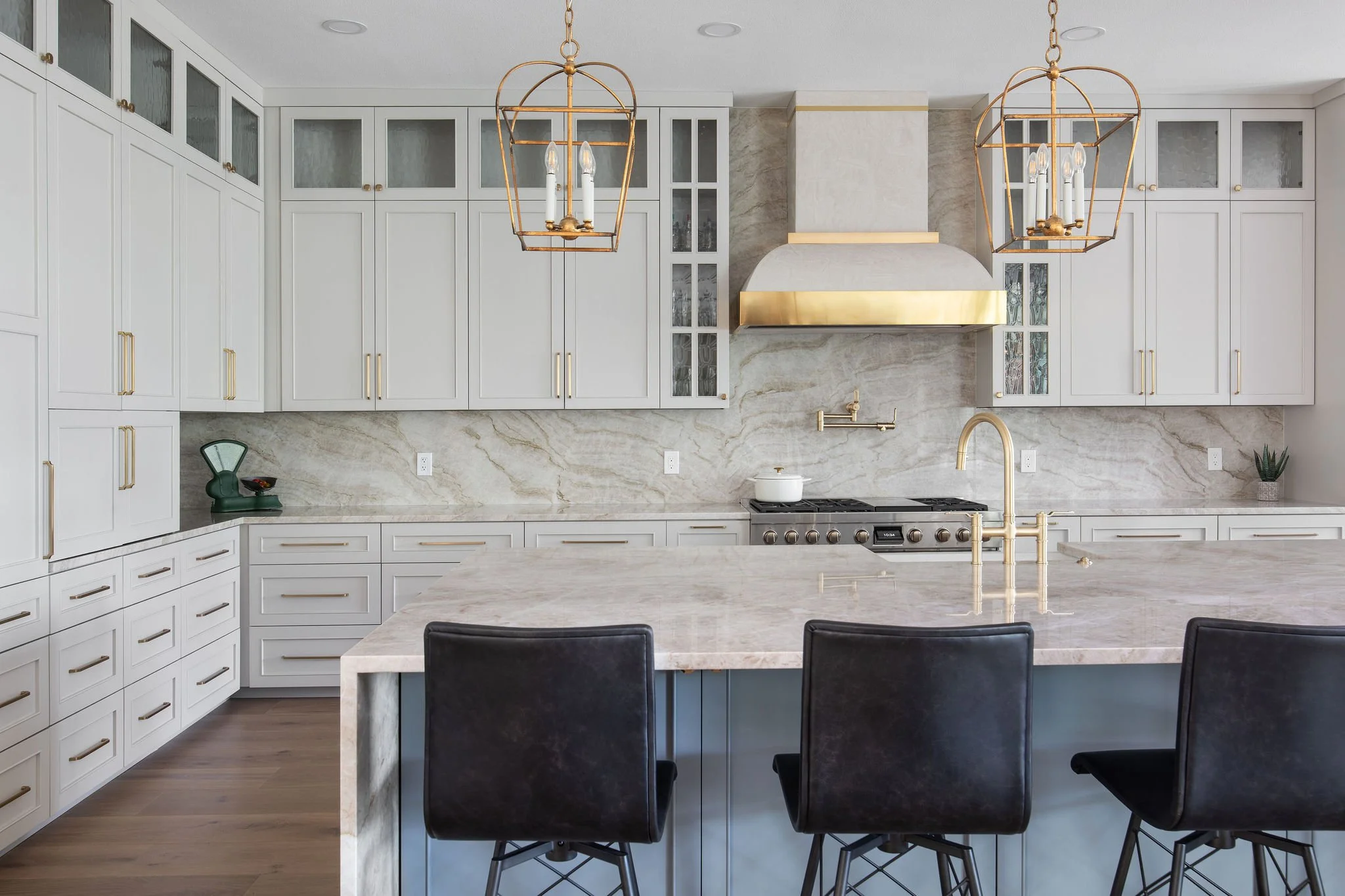
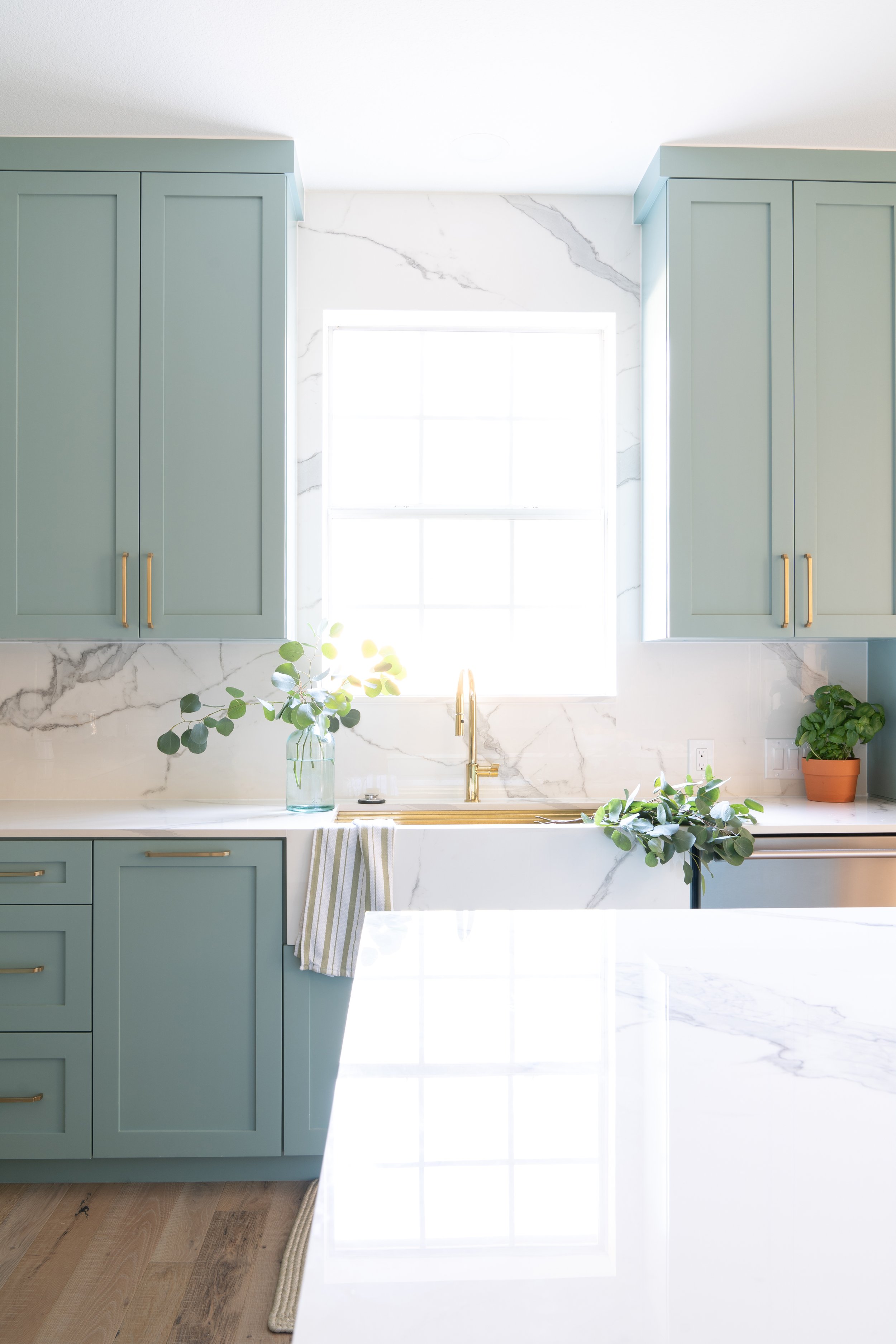
Full-height slab — running the countertop material up to the underside of the uppers or to the hood — is the cleanest detail available and eliminates grout entirely. It's also where you can use a stone that would be a poor countertop choice, because vertical surfaces don't get cut on. Watch three things: material yield (a full-height splash can add a slab or more to the order), the vein continuity from counter to wall, which is a design decision that needs to be made at slab layout, and the outlet locations, which need to be coordinated early because moving them later means cutting stone in place.
Tile remains the right answer often. It introduces texture and scale that slab can't, and it costs far less.
Whatever the material, three details separate a good installation from a callback:
Movement accommodation. This is a written standard, not an opinion. The TCNA Handbook's movement joint detail (EJ171) and ANSI A108 require movement joints at all inside corners, at changes of plane, and wherever backing materials change — which includes the junction where the backsplash meets the countertop. That joint gets a flexible sealant meeting ASTM C920 (silicone, urethane, or polysulfide), color-matched to the grout. Grout in that joint will crack. It always cracks. Any tile setter who argues the point can be pointed to the handbook.
Substrate and waterproofing. Behind a sink and behind a range, the wall assembly matters. Specify it rather than assuming it.
Behind the range specifically. Heat and grease both concentrate here. Porous, unsealed materials in this zone will discolor. If a stone or a handmade tile is going behind the cooktop, understand its absorption and plan the maintenance.
What Makes a Good Installation?
Material selection is maybe half the outcome. The rest is fabrication and detailing, and this is where an experienced builder earns the fee.
Slab selection and layout. For any high-movement stone, the slabs must be selected in person and, ideally, the whole bundle reserved. Bookmatching, waterfall continuity, and vein alignment across a seam all require sequential slabs cut from the same block — they cannot be assembled after the fact from separate purchases. Before fabrication starts, a layout should be approved showing where each piece comes from on each slab and where every seam falls. Digital slab-layout software makes this straightforward, and any fabricator working at this level should offer it as standard. If they don't, that's informative.
Thickness and edge. Slabs are typically 2cm or 3cm. A 3cm slab produces a substantial edge directly. A 2cm slab can be laminated or mitered to read as thicker — 2", 3", 4", or more — which is how the heavy monolithic edges in contemporary design are built. Mitered edges look monolithic but require precise fabrication and, on veined stone, careful vein alignment through the miter so the pattern appears to wrap the corner. Done poorly, the seam at the miter is the first thing the eye finds.
Seams. Seams are inevitable on most kitchens. What's negotiable is where they fall and how well they're executed. They should be located over cabinet supports, away from focal points, and planned around cutouts rather than through them. A well-executed seam is color-matched with tinted epoxy and pulled tight with seam setters; the goal is a joint you have to look for.
Overhangs and support — the numbers people get wrong. This is where seating islands fail. The Natural Stone Institute's Dimension Stone Design Manual sets the limits plainly: unsupported span of 3'-0" (900mm) for 1-1/4" / 3cm stone and 2'-0" (600mm) for 3/4" / 2cm stone; cantilever beyond a one-sided support limited to 10" (250mm) at 3cm and 6" (150mm) at 2cm; and in no case may the cantilevered portion exceed one-third the width of the countertop. The DSDM is a consensus industry manual rather than adopted building code, and actual capacity varies with the specific stone's flexural strength — but if a fabricator wants to depart from these figures, ask them to explain why in writing.
The practical consequence: a 15" seating overhang on a 3cm island needs steel. Not decorative corbels — flush-mounted steel plate or a supporting substrate, sized and fastened into structure. This gets designed during cabinetry, not discovered at template. Sintered slab in thinner formats has its own support requirements and frequently needs a continuous subtop.
Sequencing. Template happens after cabinets are set and level and after the actual appliances — not the spec sheets — are on site. Sink and cooktop cutouts are fabricated to the physical unit. Fabrication commonly runs two to three weeks after template. Building that into the schedule up front avoids the most common late-stage compression in a kitchen renovation.
Living in Central Texas
Sealing, honestly. A quality impregnating sealer reduces liquid absorption. It reduces staining. It does not prevent etching, it does not prevent scratching, and it is not a warranty. Test whether a stone needs it by leaving a few drops of water on an inconspicuous area for fifteen minutes — if the stone darkens, it's absorbing, and sealer will help. Many dense granites and quartzites won't darken at all.
Water. Austin Water's published hardness averages around 93 ppm — roughly 5.4 grains per gallon, moderately hard. Many homes in the surrounding Hill Country, on well water or outlying MUD systems, run considerably harder. On dark honed surfaces and on undermount sink reveals, that shows up as mineral spotting. It's cosmetic and removable, but it's the kind of daily annoyance worth anticipating — either through a softener or by steering finish selection.
Cleaning. pH-neutral cleaner, always. Vinegar, bleach, and most general-purpose sprays will damage calcite-based stone. Blot spills rather than wiping them across the surface. Use a cutting board — not because the stone will be hurt, but because quartzite and granite will destroy your knives.